7 Pillars
The seven concepts that hold my spiritual practice together.

I’ve been thinking about the way that I move in my own practice a lot lately. The things that I do, the reasons I do them, the priorities I have and the ways that I centre them. And when I took stock of all of the various things that I do, whether they’re in communion with higher/unseen/divine realms, or they’re things that I do to feel well and whole in this lifetime, or they’re ways of relating with the rest of the material world, I noticed that there are certain throughlines that seem to connect them all. I counted 7 in total, and I’m going to give a quick overview of each of them now.
Intention
I’m starting with intention, because the why of my spiritual practice is usually the first thing I need to consider when I’m engaging with it. What is the reason I’m doing this? What is the outcome I’m hoping for? I don’t want to just go through the motions of lighting candles, tending to my altar, or sitting down to meditate because I feel like it’s something I should be doing. Intention is the thing that’s going to give these actions power.
Let’s say I’m beginning one of my favourite post-work rituals; I’m drawing myself a hot bath with epsom salts in it, I’m lighting candles and I’m grabbing a wand of lavender or mugwort to burn. It would be easy to just do these things one after another with no thought, but then I’m just having a bath with some candles (and a little bit of plant smoke in the air). My intention with this bath is to cleanse myself of my clients’ energy from the day, to reset my own, to soothe my body and nervous system, and to invite in any clarity or insights that the unseen realm might have for me after a day of channeling energy. This is much more than just a bath.
So while I’m drawing the bath and pouring in the salt I’m thinking about how nice it’s going to feel for my muscles that are tired after a day of massaging. When I burn the plant I’m saying thank you to the spirit of fire and the spirit of the plant for carrying away the energy of others with its smoke. When I light the candles I’m acknowledging that the fire is acting as a portal between worlds so that my guides have an easy channel to interact with me through. And when I get in the tub I’m saying thank you to the water for restoring my energy field.
Intention is what makes these things a ritual, and it’s the signal that triggers things into action.
Connection
Most of the things I spoke about in the example above about the bath have just as much to do with connection as they do with intention. And that’s because a major part of my spirituality is recognizing that I’m not alone, that there are unseen beings and energetic movement all around me, and that we all benefit from being in good relationship with one another. This is reflected in my animistic beliefs, which are based on the idea that almost everything has a unique spirit, including plants, rocks, water, fire, wind, art, songs, etc. My views about the earthly realm and the spirit realm, and how communication can go both ways between them, also plays a major role in the importance of connection in my spiritual practice.
In fact, most of the things I would consider part of my spiritual life are actually just rituals of connection and relationship. When I meditate I’m connecting to the unseen realm and communicating with my guides. When I tend my altar I’m usually doing so for my ancestors, another unseen connection that’s important to me. When I go to the woods and lay next to a tree and greet it like a friend, it’s nothing except a bid for kinship with the spirits of the land that are all around me. The focus on connection to past, present and future, to place, and to the living world are integral to my spirituality.
Simplicity
In order to maintain any kind of consistency in my spiritual practice, I need to keep things simple. I’m not the type of person who does complicated rituals and ceremonies. I love learning and getting into all of the details of the concepts that I study, some of which can get quite convoluted and complex, but when it comes to my actual ways of living I find it better to stick to a few routines that I can fully embody before even entertaining the idea of adding anything else.
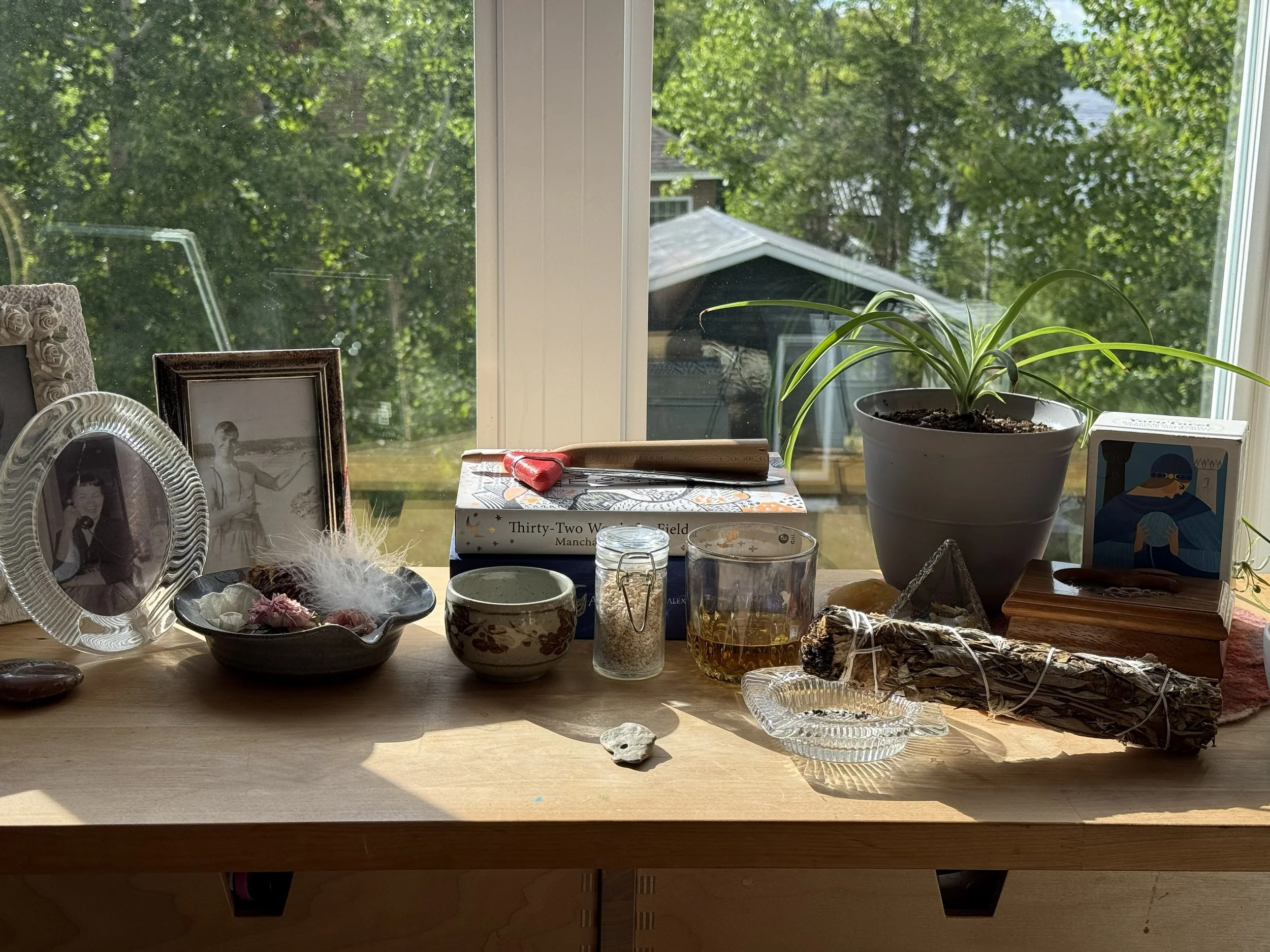
I’ll explain this with the example of altars: there is a lot of information out there about the proper way to set up an altar. What you should put on it, what kind of cloth you should use, which pictures and items (if any) you should include, what colour candle to light, what types of offerings to leave (and when), where on your altar you should place each thing… and it all differs based on what spiritual tradition or lineage you’re carrying on. And there are good reasons for each altar rule! Protection, amplification, customs of cultures that don’t want to be forgotten.
But my spiritual practice is personal. And getting lost in the details and stressing about doing things right doesn’t work for me, personally. I would much rather focus on my intention and connection instead of getting lost in all the diverse ways I might be messing it up.
Repetition
Something that lends itself well to keeping things simple is repetition, which is important for me in order to maintain consistency. Having a nice, simple practice is great, but it won’t become embodied and embedded into my everyday life if I don’t repeat it over and over (and over and over). This is pretty straightforward! And also probably why it’s called a spiritual practice.
There are lots of reasons why repetition is important. Doing things over and over again builds and strengthens neural pathways in the brain. And it also creates and solidifies pathways in the spirit realm. Think of it this way: if I start meditating and connecting with the unseen, I’m going to be pretty shaky at it the first time. I’m carving a new trail in the wilderness. But if I keep returning to it, walking the same path, that trail is going to become more familiar and my footsteps are going to make that trail clearer and less hazardous every time.
Creation
This is something that I thought was separate from my spiritual practice for a long time, but have come to realize is actually a crucial part of it. Creation is what I do with the insights and inspirations that arrive to me from the spirit realm. It’s acting on the ideas that present themselves to me! Those relationships with the unseen that I’ve been cultivating? They speak back to me in many ways. Sometimes it’s through a feeling, a little spark of energy that I can sense in my body. Sometimes it’s through a sudden coincidence, a new opportunity popping up, a roadblock miraculously moving out of my way. And sometimes it’s through an idea. Through creation, I’m able to move these things from the spirit realm through me and out into the world, where they can foster further connection with the people around me.
Creation is expression. It’s taking the thing that’s on the inside and putting it out into the world. So creation can be many things; getting an outfit together, writing a song, making a meal, doing a dance, telling a story, carving a block of wood. You’re using something within yourself to alter the material world in some way. For me, creation often comes through in paintings, in spinning wool, in writing something like this. I’m creating an online course right now. Maybe you create events, or beautiful spaces.
Making creation a pillar of my spiritual practice means that I can honour what it truly is (the outward expression of my spiritual energy) while making sure that I don’t put it to the side or put it off for later in favour of “more important” endeavours. Creation is crucial.
Responsibility
This is the thing that makes my spiritual practice whole. And it’s the part that I think a lot of modern/new age spiritual spaces are missing. It’s the understanding that this isn’t just about me. It’s not just about my experience, my insights, and what I’m able to get from the physical or spiritual worlds. I’ve been talking a lot about relationship and connection in this article, and there can be no relationships without the responsibilities that maintain them.
You’ve hopefully heard of the phrase “being in right relationship”. I first head it when I was studying Irish Paganism through an online school (the Irish Pagan School) and then again when I was reading the incredible books of Robin Wall Kimmerer, like Braiding Sweetgrass and The Serviceberry. It’s the idea of reciprocity. That you can’t only take, you have to be giving back in return. It applies to our relationships with humans and non-humans, and says that if you benefit from them, you should also make sure they benefit from you.
And there are other responsibilities, too. Aside from basic reciprocity I believe I have a responsibility to care for the most vulnerable beings in our society, including children and the people our culture tries to forget about and leave behind because they aren’t considered productive enough. I have a responsibility to care for and protect the natural world, I have a responsibility to move right in this lifetime for the sake of future generations, and I have a responsibility to use the things the spirit world has put in my lap in order to improve the lives and conditions of the world around me. For the greater good of all.
Gratitude
The final pillar of my spiritual practice is noticing and being thankful for the many miraculous and beautiful things in my life! This is the easiest and most immediately gratifying part of the whole thing, because the second I start looking around and intentionally taking stock of the things I’m grateful for, the better and more uplifted I feel and the more ready I am to keep going with all the rest. My life is full of blessings. Some that I’ve worked hard for and others that have seemingly come out of nowhere.
I started with intentional gratitude by including it in my journaling. You know, a little daily gratitude list. This was when I was just starting out and needing all the help I could get. Now I don’t need to make a list to remember to feel deep gratitude. I look around and feel this way multiple times a day. This is a great example of repetition leading to embodiment.
It’s been my experience that the more you can focus wholeheartedly on the good, the more good you’ll experience. Whether this is because it actually invites more of the good things into your life (as in the law of attraction) or because it’s training your brain to notice the good more often, I don’t really know. And I don’t really care! I don’t need to complicate it (and see, there’s that simplicity pillar at work again…)
Conclusion
Hopefully I’ve given you a couple of ideas here for creating, upgrading or simplifying your own spiritual practice! I believe that everyone’s journey is going to look a little bit different, and this is just what works best for me right now. As always, thank you for reading, xoxo Sarah